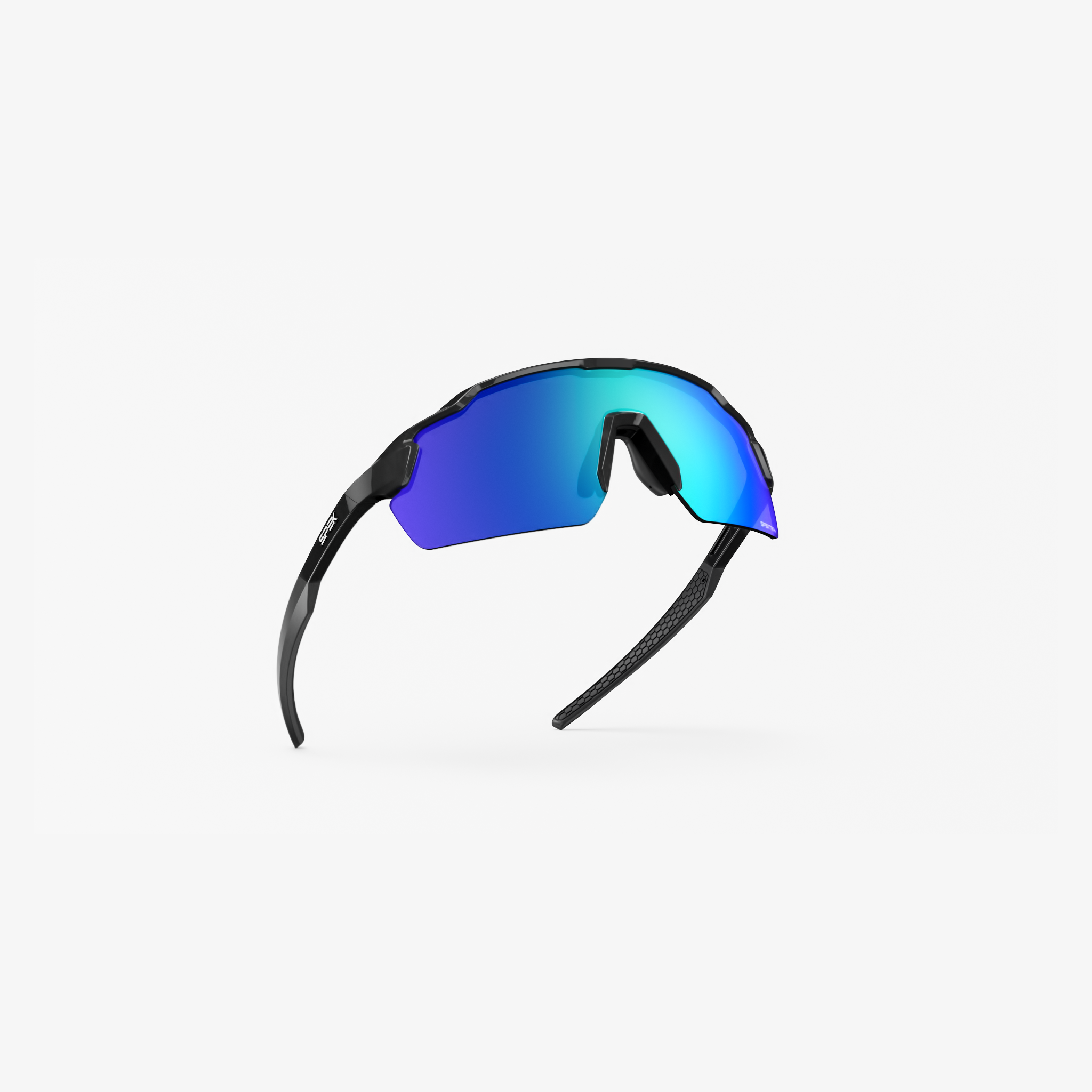
TECHNOLOGY
The engineering behind the lens.
Every technical decision exists for a reason. No invented names for generic technology. What you read here is what you wear.
SPEKTRA+™
In full sun, excess light flattens everything. Colors blur together, shadows disappear. Everything looks the same shade.
A standard lens darkens everything uniformly. Everything gets darker, but colors stay just as close to each other. The contrast problem isn't solved.
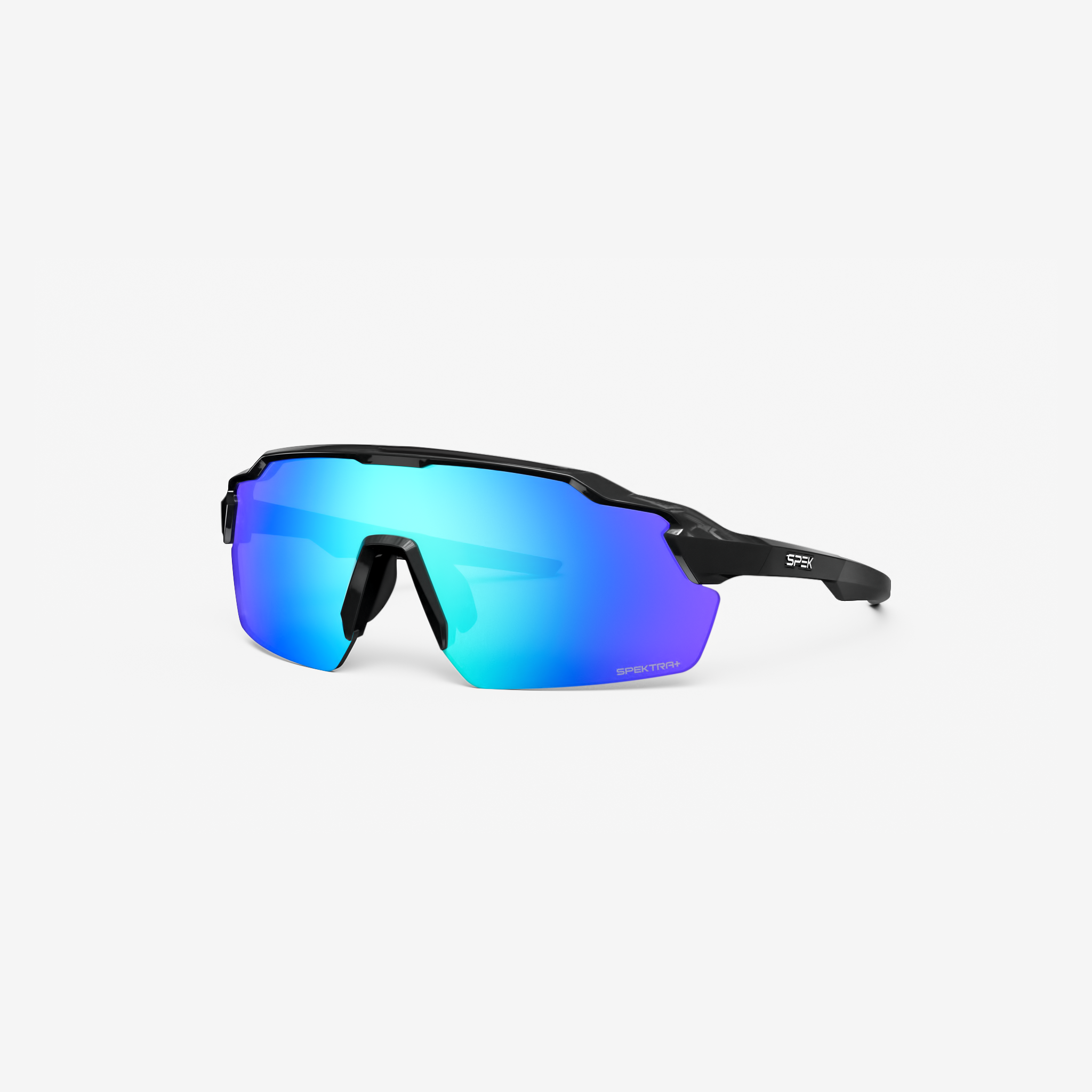
SPEKTRA+™ works differently. The treatment is embedded in the polycarbonate and selectively filters specific wavelengths of light. Those are the wavelengths that cause similar colors to blur together. By reducing them, the lens creates more separation between tones that would otherwise look the same.
The result: terrain detail becomes easier to read. Road, shadow, and vegetation stand apart. It's not a color shift. It's better readability of what's already there.
Our SPEKTRA+™ lenses use a grey base. Light is reduced neutrally, without altering color temperature. Colors stay true to life, with more definition between them.
 Standard lens
 SPEKTRATM
Five coatings. One lens.
Every Spek lens is built in five layers. The SPEKTRA+™ lens forms the base. Three surface coatings are applied over it to protect the lens and make it easier to maintain. A shock absorption layer completes the structure.

A fixed lens forces you to choose your conditions. In the forest, it's too dark, while in full sun, it's too light, and you end up wearing the wrong lens half the time.
The EVO+™ photochromic lens automatically adjusts to ambient light by darkening in strong sunlight and lightening when the light decreases, with a continuous and stepless transition.
The photochromic molecules are integrated directly into the lens material rather than applied as a surface coating, which means they don't wear out over time and react uniformly across the entire surface.
The result is a single lens that covers conditions from under the canopy to full sun, without having to change lenses along the way.


A fixed lens forces you to choose your conditions. In the forest, it's too dark. In full sun, it's too light. You end up wearing the wrong lens half the time.
EVO+™ is a photochromic lens. It automatically adjusts to ambient light. When the sun is strong, the lens darkens. When the light dims, it lightens. The transition is continuous, with no steps.
Photochromic molecules are integrated directly into the lens, not in a surface layer. This means they don't wear out over time and react uniformly across the entire surface.
The result: a single lens that covers conditions from overcast to full sun. No need to change lenses along the way.

Ultraviolet rays are invisible, but they cause cumulative damage to the eyes over the years. Prolonged exposure can accelerate the development of cataracts, macular degeneration, and corneal burns, with effects that accumulate even on cloudy days.
All Spek lenses block 100% of UVA, UVB, and UVC rays up to 400 nanometers, which corresponds to the highest protection standard recognized by eye health authorities.
UV protection is integrated into the lens itself and has nothing to do with tint or opacity. A clear lens offers the same protection as a dark lens, and this protection does not wear off over time.

SUNGLASSES


KOVO Crystal Rose